
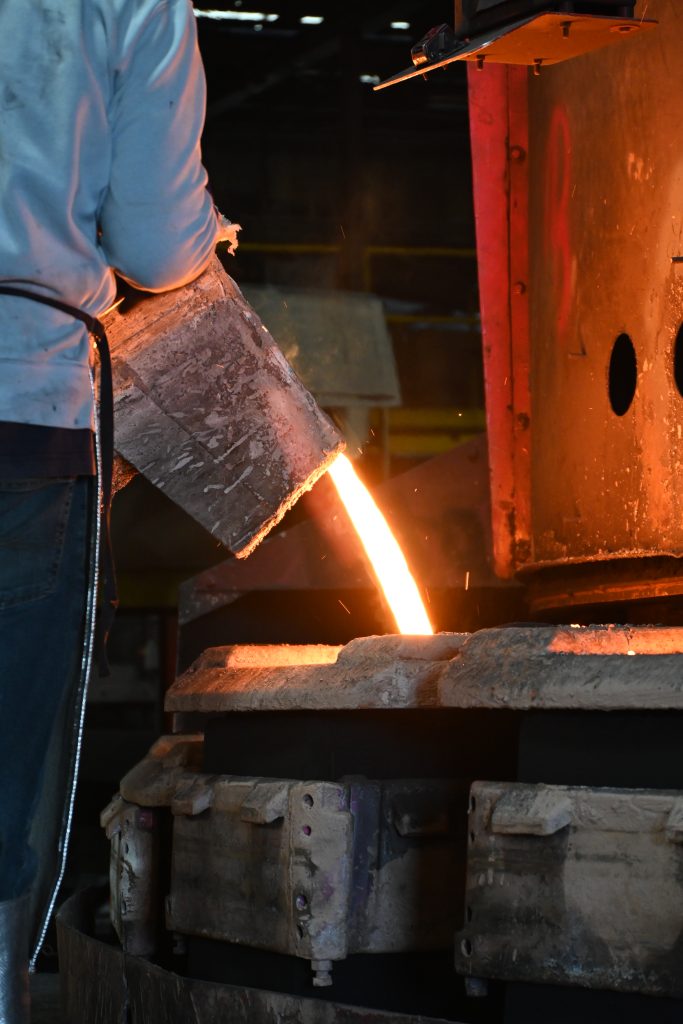
Pacific Alloy Casting Company manufactures austenitic steel castings in accordance with ASTM A351, a specification covering corrosion-resistant steel castings intended for pressure-containing and structural applications.
Austenitic steels are commonly selected for environments involving corrosion, elevated temperatures, thermal cycling, or chemical exposure, where carbon steel or cast iron may not provide adequate performance.
Austenitic steels are iron-based alloys containing significant amounts of chromium and nickel, which stabilize an austenitic microstructure. This structure provides a unique combination of:

Austenitic steel castings produced to ASTM A351 offer:
These properties make austenitic steel suitable for demanding service conditions where material failure would result in downtime or safety concerns.
Typical applications for Austenitic Steel Castings:
Pacific Alloy manufactures austenitic steel components used in applications such as:
Final grade selection depends on corrosion exposure, temperature, pressure, and mechanical loading.
| Property | Detail |
|---|---|
| Common Name / Type | Austenitic (and some duplex) stainless steel castings (specified by grade, e.g., CF3, CF8, CF3M, CF8M, CF8C, CN7M, CK3MCuN, plus duplex grades like CD4MCu) |
| Material Class | Cast austenitic stainless steel — pressure-containing; cast equivalents of wrought 304/304L/316/316L and related grades |
| Grade Designation Basis | ACI grade codes: first letter C = corrosion-service; second letter indicates Cr-Ni level; numbers/letters denote carbon and additions (e.g., CF8 ≈ cast 304, CF8M ≈ cast 316, CF3/CF3M = low-carbon "L" versions, CF8C = stabilized) |
| Key Composition | (CF8M example) Cr 18–21%, Ni 9–12%, Mo 2.0–3.0%, C ≤ 0.08%, Mn ≤ 1.5%, Si ≤ 1.5%; "3" grades cap carbon at ≤ 0.03% for weld corrosion resistance; balance Fe |
| Microstructure | Austenitic matrix, typically with a controlled small fraction of ferrite (improves castability, strength, and stress-corrosion resistance); CN7M and others fully austenitic |
| Hardness | ~ 140–190 BHN (relatively soft, work-hardens) |
| Tensile Strength | ~ 65–80 ksi depending on grade (CF8/CF8M ≈ 70 ksi min) |
| Yield Strength | ~ 28–37 ksi depending on grade |
| Elongation | ~ 30–35% min — excellent ductility |
| Toughness / Ductility | Excellent — austenitic structure gives high ductility and impact toughness, including very good low-temperature/cryogenic performance |
| Standout Property | Broad corrosion resistance in cast, pressure-rated form — the cast counterparts of 304/316 stainless, with excellent ductility and weldability |
| Heat Treatability | Solution-annealed (heated and rapidly quenched) to dissolve carbides and maximize corrosion resistance — not hardened by heat treatment (austenitic steels harden only by cold work) |
| Machinability | Fair — gummy, work-hardening cut typical of austenitic stainless; requires sharp tooling, positive feeds, and rigid setups; more difficult than carbon steel |
| Weldability | Excellent — readily weldable, especially the low-carbon "L" (CF3/CF3M) and stabilized (CF8C) grades that resist sensitization; a key advantage for fabrication and repair |
| Corrosion / Oxidation Resistance | Excellent — broad resistance to many acids, chlorides (Mo-bearing CF8M/CF3M notably better in chlorides), and oxidizing media; good high-temperature oxidation resistance |
| Temperature Range | Wide — excellent from cryogenic temperatures up through elevated-temperature service; retains toughness at very low temperatures |
| Relative Cost | High — significant chromium, nickel, and (Mo grades) molybdenum content; well above carbon and low-alloy steel castings |
| Best-Fit Applications | Valve and pump bodies, fittings, and pressure-containing parts for chemical, petrochemical, food, pharmaceutical, and cryogenic service; corrosive and clean-process equipment where 304/316-type resistance is needed |
| Not Recommended For | High-strength structural duty (modest yield), severe chloride/stress-corrosion environments better served by duplex (A890/A995), or abrasion service |
Austenitic steel is typically selected when:
For applications dominated by abrasion rather than corrosion, abrasion-resistant cast irons may be more appropriate. For purely structural needs without corrosion, carbon steel may be sufficient.
Pacific Alloy Casting Company produces ASTM A351 castings using controlled foundry processes that focus on:
Castings are manufactured to customer specifications and application requirements.

If you’re evaluating austenitic steel for a corrosion-resistant or high-temperature application and need guidance on grade selection or production capability, Pacific Alloy is ready to help.
Discuss Your Casting Requirements
📞 562-928-1387
✉️ sales@pacificalloy.com
Early-stage discussions welcome. NDAs available.