
Pacific Alloy Casting Company manufactures Gray Iron castings in accordance with ASTM A48, the most widely used specification for gray iron. As the earliest form of cast iron, gray iron remains one of the most versatile foundry materials due to its excellent castability, machinability, and vibration-damping characteristics.
Gray iron is an alloy primarily composed of iron, carbon, and silicon. The high carbon content results in graphite forming as flakes within the iron matrix, giving gray iron its characteristic fracture appearance and performance traits.
This graphite structure provides:
These properties make gray iron well-suited for a wide range of industrial castings.

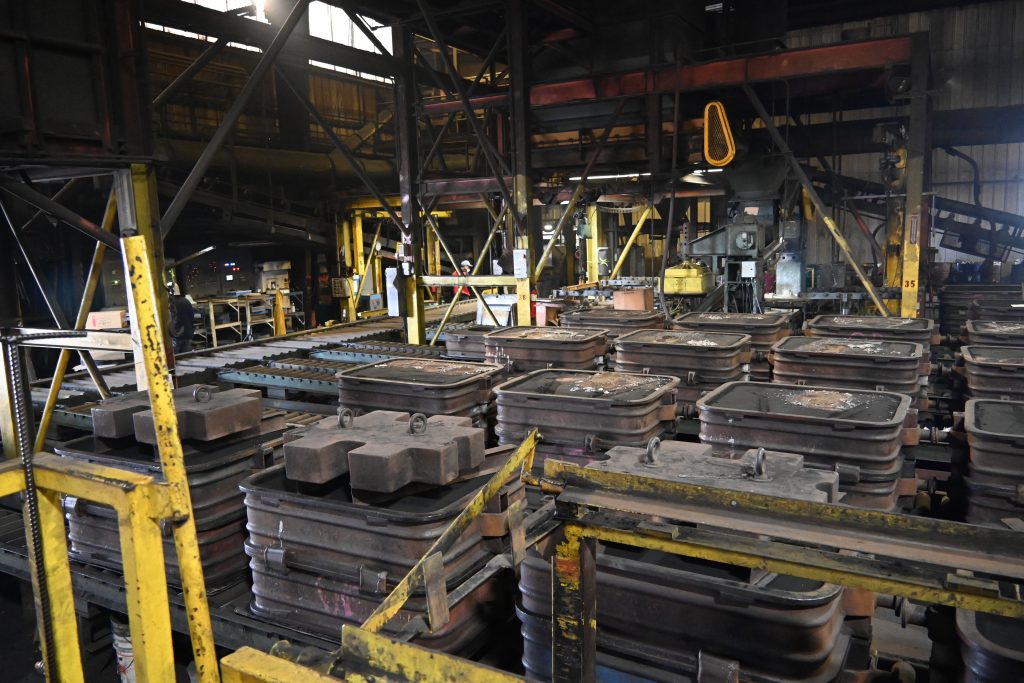
Gray iron castings produced to ASTM A48 offer:
ASTM A48 classifies gray iron grades based on the tensile strength of separately cast test bars, allowing material selection to be matched to application requirements.
| Property | Detail |
|---|---|
| Common Name / Type | Gray cast iron; flake-graphite cast iron (specified by Class: 20, 25, 30, 35, 40, 45, 50, 55, 60) |
| Material Class | Gray iron — graphitic cast iron |
| Class Designation Basis | The class number equals the minimum tensile strength in ksi (e.g., Class 30 = 30,000 psi min tensile) |
| Key Composition | C 2.5–4.0%, Si 1.0–3.0%, Mn 0.2–1.0%, plus P and S; composition adjusted to control graphite flake formation (not tightly specified by the standard — properties govern) |
| Microstructure | Graphite flakes in a pearlitic, ferritic, or mixed matrix; flake structure gives gray iron its characteristic properties |
| Hardness | ~ 150–270 BHN (rises with class — lower classes softer/ferritic, higher classes harder/pearlitic) |
| Tensile Strength | 20–60 ksi depending on class (Class 20 = 20 ksi min up to Class 60 = 60 ksi min) |
| Compressive Strength | Very high — typically 3–4× tensile strength; gray iron excels in compression |
| Toughness / Ductility | Low ductility, low impact resistance — the graphite flakes act as internal stress risers; essentially no measurable elongation |
| Standout Property | Exceptional vibration damping, excellent machinability, good thermal conductivity, and dimensional stability — all at low cost |
| Heat Treatability | Limited — can be stress-relieved or surface-hardened (flame/induction) on higher-carbon-equivalent grades; not through-hardened for strength like steel |
| Machinability | Excellent — the graphite flakes break chips and lubricate the cut; one of the most machinable of all ferrous materials (lower classes machine easier than higher) |
| Weldability | Poor to fair — requires preheat, slow cooling, and nickel-based electrodes; prone to cracking and hard heat-affected zones. Generally a repair process, not a fabrication method. |
| Corrosion / Oxidation Resistance | Low to moderate — forms a protective graphitic surface in some media; suitable for water and mild environments but not aggressive corrosion |
| Relative Cost | Low — among the most economical cast materials; easy to cast in complex shapes |
| Damping Capacity | Outstanding — the single best property for many applications; absorbs vibration far better than steel or ductile iron |
| Section-Size Sensitivity | Significant — section thickness affects cooling rate and therefore strength/hardness; thicker sections develop lower strength, which is why test bars are sized to the casting |
| Best-Fit Applications | Engine blocks and cylinder heads, machine tool bases and frames, gearbox and pump housings, brake drums and rotors, manifolds, flywheels, counterweights, and pipe — anywhere damping, machinability, and economy matter more than tensile strength |
| Not Recommended For | Tensile or shock-loaded structural parts, pressure-containing parts needing ductility, or applications requiring impact toughness |
Pacific Alloy manufactures gray iron components used in applications such as:
Gray iron is often selected where load-bearing requirements are moderate and cost-effective manufacturing is a priority.

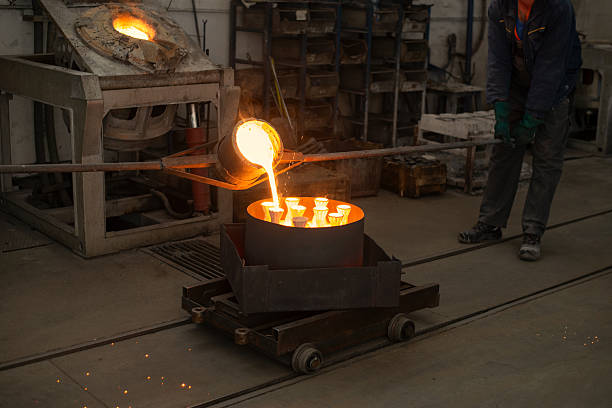
Gray iron is typically chosen when:
For applications requiring higher strength or toughness, ductile iron or steel may be considered.
If you’re evaluating gray iron for a specific application and need guidance on grade selection or production capability, Pacific Alloy is ready to help.
Discuss Your Casting Requirements
📞 562-928-1387
✉️ sales@pacificalloy.com
Early-stage discussions welcome. NDAs available.