
Pacific Alloy Casting Company manufactures abrasion-resistant white cast iron castings in accordance with ASTM A532, a specification covering cast iron alloys engineered for high resistance to abrasive wear.
These alloys are widely used in applications where material loss due to abrasion is the primary failure mode and service life must be maximized under demanding operating conditions.
Pacific Alloy Casting Company produces abrasion-resistant cast iron components using controlled foundry processes that support:
Castings are manufactured to customer specifications and application requirements.

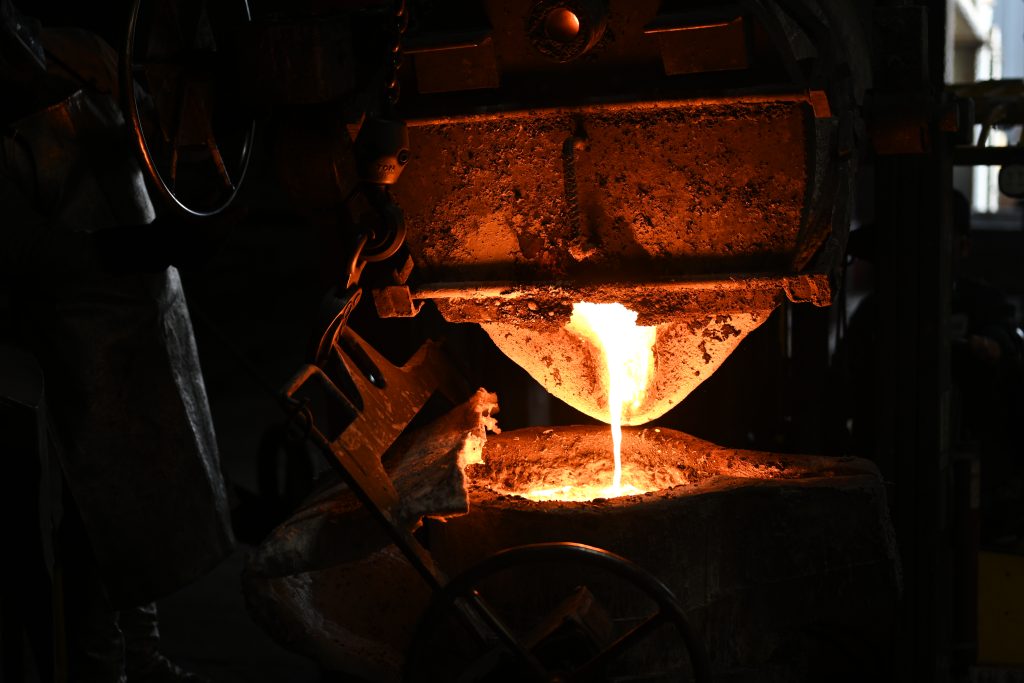
ASTM A532 defines several classes of white cast irons alloyed to improve resistance to abrasive wear. These irons are characterized by a hard, carbide-rich microstructure that provides exceptional wear resistance in sliding and erosive environments.
While ASTM A532 includes multiple alloy classes, the majority of industrial abrasion-resistant castings fall into two primary alloy families:
Each alloy family offers distinct performance characteristics suited to different service conditions.
Ni-Hard is a nickel-alloyed white cast iron that has served as an industry standard for abrasion resistance for more than six decades.
Key characteristics include:
Typical applications include:
Common Ni-Hard castings include mixer liners, mill liners, mixer tips, and slurry pump components.
Hi-chrome white irons, often referred to as Hi-Chrome or Chrome Carbide, contain elevated chromium levels to improve abrasion resistance and toughness.
Key characteristics include:
Typical applications include:
High-chrome iron is often selected when abrasion resistance must be combined with additional toughness or corrosion resistance.
Choosing between Ni-Hard and high-chrome iron depends on several factors, including:
Pacific Alloy works with customers to evaluate these factors and recommend the most appropriate ASTM A532 alloy for the application.

High-chrome white irons, often referred to as Hi-Chrome or Chrome Carbide, contain elevated chromium levels to improve abrasion resistance and toughness. Castings produced to ASTM A532 offer:
When compared to nickel-alloyed white irons, Hi-Chrome iron is often selected when additional abrasion resistance or toughness is required.

Chrome carbide white iron (ASTM A532 Grade IIB) is a 12% chromium white iron engineered for applications requiring high abrasion resistance with improved impact tolerance. The elevated chromium content promotes the formation of hard chromium carbides, delivering exceptional wear life in moderate- to high-impact service. Typical applications include mining wear parts, grinding mill components, aggregate processing equipment, and bulk material handling systems where service conditions demand both hardness and durability.
Chrome carbide white iron offers a performance profile tailored to severe wear environments:
| Property | Detail |
|---|---|
| Common Name / Type | 12% Cr white cast iron; Class II Type B chromium-molybdenum white iron |
| Material Class | High-chromium white iron (abrasion-resistant) |
| Key Composition | C 2.4–3.6%, Cr 11.0–14.0%, Mo up to 3.0%, Mn up to 2.0%, Ni up to 2.5%, Si up to 1.5% |
| Microstructure | M₇C₃ chromium carbides in a martensitic / austenitic matrix (matrix adjustable by heat treatment) |
| Hardness — As-Cast | ~ 450–550 BHN |
| Hardness — Hardened (heat-treated) | ~ 600–650 BHN (up to ~ 60+ HRC) |
| Tensile Strength | Low / not a design parameter — material is consumed in compression and abrasion, not tension |
| Toughness / Ductility | Low; brittle — moderate impact resistance for a white iron but far below steels or ductile iron |
| Standout Property | Excellent abrasion resistance with better fracture toughness than higher-carbide grades, thanks to the discrete (rather than continuous) carbide structure |
| Heat Treatability | Yes — can be hardened and tempered; matrix can be tuned (austenitic-as-cast for toughness, or hardened for max wear). A key advantage over Ni-Hard grades. |
| Machinability | Poor. Hard carbides make conventional machining impractical — typically ground or finished with CBN/diamond tooling. Best practice is to machine in the soft/annealed condition (if used) before final hardening, or design for grinding only. |
| Weldability | Poor / not recommended. High crack sensitivity from hard, brittle structure. If repair welding is unavoidable, use high-preheat and specialized high-alloy electrodes; structural welding should be avoided. |
| Corrosion / Oxidation Resistance | Moderate — the elevated chromium gives better mild-corrosion and oxidation resistance than low-Cr (Ni-Hard) white irons, though well below stainless or 25% Cr grades. |
| Relative Cost | Moderate — higher than gray iron, generally lower than the 25% Cr (Grade III) irons. |
| Section-Size Sensitivity | Moderate — heavier sections cool slower and may need controlled heat treatment to achieve target hardness throughout. |
| Best-Fit Applications | Mining and mineral processing wear parts, grinding mill liners and components, slurry pump parts, classifier shoes and wear plates, crusher components, and high-stress abrasion environments where some impact loading is present. |
| Not Recommended For | Tensile/structural load-bearing parts, weld-fabricated assemblies, high-impact shock loading, or parts requiring extensive post-cast machining. |
Notes: Grade IIB sits between the Ni-Hard grades (I/II) and the high-chromium 25% Cr grade (IIIA). Compared to Ni-Hard, its discrete M₇C₃ carbides and heat-treatable matrix give a better balance of abrasion resistance and impact toughness. Compared to Grade IIIA, it offers lower material cost but less corrosion/oxidation resistance. It’s the go-to when an application needs heavy abrasion resistance with a degree of impact durability, and when the part can be finished by grinding rather than machining.
High-Chromium White Iron for Severe Abrasion Service
Pacific Alloy Casting Company manufactures Chrome Carbide castings in accordance with ASTM A532 Class III. Chrome Carbide is a high-chromium white iron alloy engineered for extreme abrasive wear environments where material longevity is critical.
Chrome Carbide castings are commonly referred to as Hi-Chrome iron and are selected when abrasion resistance is the dominant performance requirement.
Chrome Carbide castings produced to ASTM A532 Class III offer:
| Property | Detail |
|---|---|
| Common Name / Type | 25% Cr white cast iron; Class III Type A high-chromium white iron |
| Material Class | High-chromium white iron (abrasion- and corrosion-resistant) |
| Key Composition | C 2.0–3.3%, Cr 23.0–28.0%, Mo up to 1.5%, Mn up to 2.0%, Ni up to 2.0%, Si up to 1.5% |
| Microstructure | M₇C₃ chromium carbides in an austenitic or martensitic matrix; higher Cr content shifts more chromium into the matrix for corrosion resistance |
| Hardness — As-Cast | ~ 450–550 BHN |
| Hardness — Hardened (heat-treated) | ~ 550–600+ BHN (up to ~ 60 HRC) |
| Tensile Strength | Low / not a design parameter — used in compression and abrasion, not tension |
| Toughness / Ductility | Low; brittle — comparable to other white irons, with toughness tunable somewhat via matrix heat treatment |
| Standout Property | Combines high abrasion resistance with notably better corrosion and oxidation resistance than lower-Cr white irons — the defining advantage of the 25% Cr grade |
| Heat Treatability | Yes — can be hardened and tempered; matrix can be set austenitic (as-cast, tougher) or hardened to martensite for maximum wear resistance |
| Machinability | Poor. Hard carbides require grinding or CBN/diamond tooling; machine in soft/annealed condition before final hardening where possible, otherwise design for grinding only |
| Weldability | Poor / not recommended. High crack sensitivity; if repair welding is unavoidable use high preheat and matched high-alloy electrodes. Avoid structural welding. |
| Corrosion / Oxidation Resistance | Good (best of the A532 family) — the high chromium provides meaningful resistance to corrosive slurries, acidic conditions, and elevated-temperature oxidation |
| Relative Cost | Higher — the richest-alloy grade in the A532 family, generally the most expensive of the white irons here |
| Section-Size Sensitivity | Moderate — heavier sections may need controlled heat treatment to develop uniform hardness through the cross-section |
| Best-Fit Applications | Corrosive and abrasive slurry pumps, brick and ceramic dies, mining and mineral processing wear parts, flue-gas and FGD components, pump volutes and impellers handling aggressive media, and high-temperature abrasive environments |
| Not Recommended For | Tensile/structural load-bearing parts, weld-fabricated assemblies, high-impact shock loading, or parts requiring extensive post-cast machining |
Notes: Grade IIIA is the premium abrasion-resistant choice in the A532 family. Where Grade IIB (12% Cr) is selected for abrasion with some impact tolerance at a lower cost, Grade IIIA earns its higher price when the service environment is both abrasive and corrosive — acidic slurries, wet processing, or elevated-temperature oxidizing conditions. If corrosion isn’t a factor, you can usually save money stepping down to IIB; if it is, IIIA is the clear pick.
If you’re evaluating abrasion-resistant cast iron materials under ASTM A532 and need support selecting the right alloy for your application, Pacific Alloy is ready to help.
Discuss Your Casting Requirements
📞 562-928-1387
✉️ sales@pacificalloy.com
Early-stage discussions welcome. NDAs available.