
Pacific Alloy Casting Company manufactures Hi-Chrome (high-chromium) white iron castings in accordance with ASTM A532-19. Hi-Chrome iron is engineered to deliver exceptional resistance to abrasive wear in demanding industrial environments.
Pacific Alloy Casting Company produces Hi-Chrome iron castings using controlled foundry practices that focus on:
Castings are manufactured to customer specifications and application requirements.
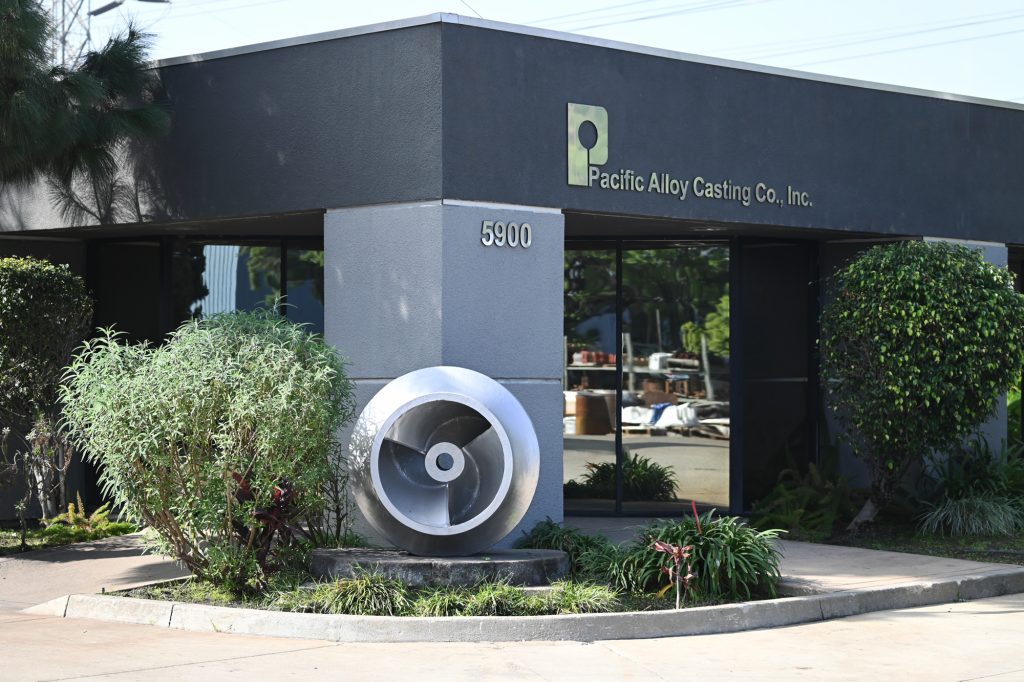
Hi-Chrome iron is a white cast iron alloyed with elevated levels of chromium to form hard chromium carbides within the iron matrix. This carbide-rich microstructure provides:
Hi-Chrome iron is also commonly referred to as Chrome Carbide iron.
Hi-Chrome iron is commonly evaluated alongside:
Selection depends on factors such as impact loading, abrasion severity, operating conditions, and desired service life.
When compared to nickel-alloyed white irons, Hi-Chrome iron is often selected when additional abrasion resistance or toughness is required.
Castings produced to ASTM A532-19 offer:
When compared to nickel-alloyed white irons, Hi-Chrome iron is often selected when additional abrasion resistance or toughness is required.

| Property | Detail |
|---|---|
| Common Name / Type | 12% Cr white cast iron; Class II Type B chromium-molybdenum white iron |
| Material Class | High-chromium white iron (abrasion-resistant) |
| Key Composition | C 2.4–3.6%, Cr 11.0–14.0%, Mo up to 3.0%, Mn up to 2.0%, Ni up to 2.5%, Si up to 1.5% |
| Microstructure | M₇C₃ chromium carbides in a martensitic / austenitic matrix (matrix adjustable by heat treatment) |
| Hardness — As-Cast | ~ 450–550 BHN |
| Hardness — Hardened (heat-treated) | ~ 600–650 BHN (up to ~ 60+ HRC) |
| Tensile Strength | Low / not a design parameter — material is consumed in compression and abrasion, not tension |
| Toughness / Ductility | Low; brittle — moderate impact resistance for a white iron but far below steels or ductile iron |
| Standout Property | Excellent abrasion resistance with better fracture toughness than higher-carbide grades, thanks to the discrete (rather than continuous) carbide structure |
| Heat Treatability | Yes — can be hardened and tempered; matrix can be tuned (austenitic-as-cast for toughness, or hardened for max wear). A key advantage over Ni-Hard grades. |
| Machinability | Poor. Hard carbides make conventional machining impractical — typically ground or finished with CBN/diamond tooling. Best practice is to machine in the soft/annealed condition (if used) before final hardening, or design for grinding only. |
| Weldability | Poor / not recommended. High crack sensitivity from hard, brittle structure. If repair welding is unavoidable, use high-preheat and specialized high-alloy electrodes; structural welding should be avoided. |
| Corrosion / Oxidation Resistance | Moderate — the elevated chromium gives better mild-corrosion and oxidation resistance than low-Cr (Ni-Hard) white irons, though well below stainless or 25% Cr grades. |
| Relative Cost | Moderate — higher than gray iron, generally lower than the 25% Cr (Grade III) irons. |
| Section-Size Sensitivity | Moderate — heavier sections cool slower and may need controlled heat treatment to achieve target hardness throughout. |
| Best-Fit Applications | Mining and mineral processing wear parts, grinding mill liners and components, slurry pump parts, classifier shoes and wear plates, crusher components, and high-stress abrasion environments where some impact loading is present. |
| Not Recommended For | Tensile/structural load-bearing parts, weld-fabricated assemblies, high-impact shock loading, or parts requiring extensive post-cast machining. |
| Property | Detail |
|---|---|
| Common Name / Type | 25% Cr white cast iron; Class III Type A high-chromium white iron |
| Material Class | High-chromium white iron (abrasion- and corrosion-resistant) |
| Key Composition | C 2.0–3.3%, Cr 23.0–28.0%, Mo up to 1.5%, Mn up to 2.0%, Ni up to 2.0%, Si up to 1.5% |
| Microstructure | M₇C₃ chromium carbides in an austenitic or martensitic matrix; higher Cr content shifts more chromium into the matrix for corrosion resistance |
| Hardness — As-Cast | ~ 450–550 BHN |
| Hardness — Hardened (heat-treated) | ~ 550–600+ BHN (up to ~ 60 HRC) |
| Tensile Strength | Low / not a design parameter — used in compression and abrasion, not tension |
| Toughness / Ductility | Low; brittle — comparable to other white irons, with toughness tunable somewhat via matrix heat treatment |
| Standout Property | Combines high abrasion resistance with notably better corrosion and oxidation resistance than lower-Cr white irons — the defining advantage of the 25% Cr grade |
| Heat Treatability | Yes — can be hardened and tempered; matrix can be set austenitic (as-cast, tougher) or hardened to martensite for maximum wear resistance |
| Machinability | Poor. Hard carbides require grinding or CBN/diamond tooling; machine in soft/annealed condition before final hardening where possible, otherwise design for grinding only |
| Weldability | Poor / not recommended. High crack sensitivity; if repair welding is unavoidable use high preheat and matched high-alloy electrodes. Avoid structural welding. |
| Corrosion / Oxidation Resistance | Good (best of the A532 family) — the high chromium provides meaningful resistance to corrosive slurries, acidic conditions, and elevated-temperature oxidation |
| Relative Cost | Higher — the richest-alloy grade in the A532 family, generally the most expensive of the white irons here |
| Section-Size Sensitivity | Moderate — heavier sections may need controlled heat treatment to develop uniform hardness through the cross-section |
| Best-Fit Applications | Corrosive and abrasive slurry pumps, brick and ceramic dies, mining and mineral processing wear parts, flue-gas and FGD components, pump volutes and impellers handling aggressive media, and high-temperature abrasive environments |
| Not Recommended For | Tensile/structural load-bearing parts, weld-fabricated assemblies, high-impact shock loading, or parts requiring extensive post-cast machining |
Pacific Alloy manufactures Hi-Chrome iron components used in industries and applications such as:
These applications rely on materials that can withstand continuous abrasive contact while maintaining dimensional integrity.

If you’re evaluating Hi-Chrome iron for a specific application and need guidance on grade selection or production capability, Pacific Alloy is ready to help.
Discuss Your Casting Requirements
📞 562-928-1387
✉️ sales@pacificalloy.com
Early-stage discussions welcome. NDAs available.